Honda’s V45 Sabre stunned the motorcycle industry when it was released in 1982. This futuristic machine, powered by a dizzyingly complex, liquid-cooled V4 engine, confirmed the Japanese manufacturer’s reputation as a technological leader. What if we told you Harley-Davidson—a company that now seems synonymous with yesterday’s technology—once designed and built a bike even more advanced than the Sabre, and was ready to release it to the public a full year ahead?
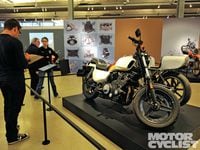
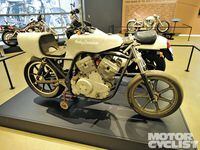
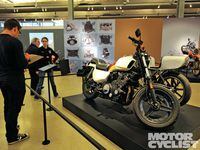
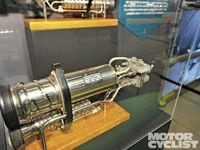
That bike was code-named Project Nova, and the final prototype is one of many never-before-seen concept vehicles featured in “Collection X: Weird, Wild Wonders of Harley-Davidson,” on display at the Milwaukee museum now. Designed in partnership with Porsche, the Nova was powered by a short-stroke, liquid-cooled, DOHC V4 rated at 135 horsepower. The chassis featured an underseat radiator and fuel tank, with a rim-mounted front brake that predated Buell’s ZTL design by more than a decade. It’s an innovative, compelling machine that almost certainly would have shifted customers’ perceptions of Harley-Davidson to an aggressive and daring brand. Unfortunately, parent company AMF killed the project early in ’81. It was deemed too risky and expensive, and funds were instead diverted to Evolution engine development.
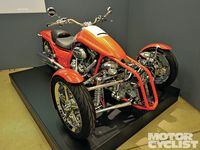
This preference of known over unknown, and past over future, is an underlying theme of Collection X. Another visionary machine cancelled just shy of production is the Penster, a radical reverse trike with computer-controlled, electro-hydraulic-assisted leaning front wheels. Who says Harley can’t develop sophisticated technology? Two versions are shown: the initial concept from ’98 built by noted hot-rod builder and Harley contract designer “Lil John” Buttera, and an orange-and-chrome ’06 version, one of four constructed during the Penster’s fifth and final development cycle. This highly refined, production-intent three-wheeler shows just how close the Penster came to market, before it was cancelled to make way for the conventional, conservative Tri Glide trike released in 2009.
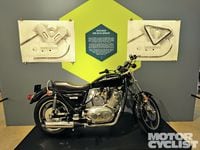
Other intriguing prototypes that never saw production include the '75 V-1100, an OHC version of the venerable Sportster platform with the "tank" forming the airbox and the fuel carried under the seat. There's also an experimental, liquid-cooled Harley/Aermacchi MX-250 motocrosser with the radiator mounted behind the front numberplate and coolant hoses run through the frame. Collection X showcases rare showbikes, a three-wheeled, Evo-powered, side-by-side roadster that might have been an updated version of the Trihawk, the 265-mph Harley-Davidson streamliner made famous by Cal Rayborn in On Any Sunday, and much more.
There are also non-bike curiosities like industrial artifacts, fine (and not-so-fine) art, apparel and other memorabilia that The Motor Company squirreled away over the last century. It’s a fascinating, candid and unprecedented glimpse into the firm’s history, and it gives an alternative vision of what we now consider to be a very conservative, tradition-bound company. You can’t help but wonder how Harley-Davidson might be different today if management had been less risk-averse in the past, and more willing to blaze forward into the future unknown.
/cloudfront-us-east-1.images.arcpublishing.com/octane/QFWSHFIAVJFYHJP2EW2WCBSQKM.jpg)
/cloudfront-us-east-1.images.arcpublishing.com/octane/E7JIQW5QUFEETJSINPACVVMNJA.jpg)
/cloudfront-us-east-1.images.arcpublishing.com/octane/ZQKXOH5IJZCGFH2R4CODE2O5DU.jpg)
/cloudfront-us-east-1.images.arcpublishing.com/octane/PGISTEH3IRAQXFQSN4JUS5HXAE.jpg)
/cloudfront-us-east-1.images.arcpublishing.com/octane/MRE3NOHY5FGX7F65XPQSIK2PTQ.jpg)
/cloudfront-us-east-1.images.arcpublishing.com/octane/4DYAKEGB2NGHDCY5NAH4P6WBOE.jpg)
/cloudfront-us-east-1.images.arcpublishing.com/octane/ES36QYKRE5BBTDISYP2ET2WNBI.jpg)
/cloudfront-us-east-1.images.arcpublishing.com/octane/UJQXWCK2W5DF5ISVW6AVKQHD5E.jpg)
/cloudfront-us-east-1.images.arcpublishing.com/octane/LWBFMM4GFRF6DMYOIFCUZKR5NA.jpg)
/cloudfront-us-east-1.images.arcpublishing.com/octane/6DLRAI6Y7RGM5BJ4XQ5S4I7B5Q.jpg)
/cloudfront-us-east-1.images.arcpublishing.com/octane/FP3BEUWUV5AXNP4XD5B2NQ2T3I.jpg)
/cloudfront-us-east-1.images.arcpublishing.com/octane/VH3KHVEPTZBW3PMW4FILG7KTRI.jpg)
/cloudfront-us-east-1.images.arcpublishing.com/octane/E3EZTFJ4SNEXREY2EOYILUINXM.jpg)
/cloudfront-us-east-1.images.arcpublishing.com/octane/ENMROQOVOVH7ZLHC7WFWJX52EM.jpg)
/cloudfront-us-east-1.images.arcpublishing.com/octane/PAC5FEGNSBBB5JLXQ6GWEBB2KI.jpg)
/cloudfront-us-east-1.images.arcpublishing.com/octane/DKBQ5TKZKFB5RGK45T344N6ZYI.jpg)
/cloudfront-us-east-1.images.arcpublishing.com/octane/ZM6HFGPAQVDAHFMPXXKVCUMU2U.jpg)
/cloudfront-us-east-1.images.arcpublishing.com/octane/MHXGBY55VFAGXNO4VTQYQF7SIU.jpg)
/cloudfront-us-east-1.images.arcpublishing.com/octane/T4SIVQJODRBGHCGMKHWAF5QYPM.jpg)
/cloudfront-us-east-1.images.arcpublishing.com/octane/3GLDHNCLSREALL4QAK5U76JILI.jpg)
/cloudfront-us-east-1.images.arcpublishing.com/octane/OFSXJJ5PZFEZ5D5ZPMCFVHJUMA.jpg)
/cloudfront-us-east-1.images.arcpublishing.com/octane/N2JLNLG44VEKBMEPORRDTMX5A4.jpg)
/cloudfront-us-east-1.images.arcpublishing.com/octane/PYWEGG6FHJD6XLPKICS7XHMMZ4.jpg)
/cloudfront-us-east-1.images.arcpublishing.com/octane/XXFQQQ4AYJDCXDGVW3JTHAYONI.jpg)